
Description
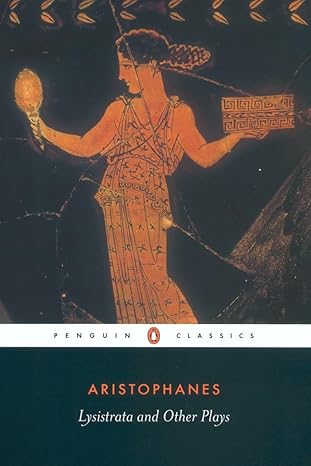
The Acharnians/The Clouds/Lysistrata’We women have the salvation of Greece in our hands’Writing at a time of political and social crisis in Athens, the ancient Greek comic playwright Aristophanes was an eloquent, yet bawdy, challenger to the demagogue and the sophist. In Lysistrata and The Acharnians, two pleas for an end to the long war between Athens and Sparta, a band of women on a sex strike and a lone peasant respectively defeat the political establishment. The darker comedy of The Clouds satirizes Athenian philosophers, Socrates in particular, and reflects the uncertainties of a generation in which all traditional religious and ethical beliefs were being challenged. Translated with an Introduction and Notes by Alan H. Sommerstein
About the Author
The title of “The Acharnians” (425 B.C.) made me ask, “Who were the Acharnians?” A quick bit of research showed me that Acharnae was a *deme* or district of Athens whose citizens were renowned for military valor; for a U.S. analogy, imagine an American playwright calling a play “The Texans” and thus capitalizing on Texans’ reputation for particular fighting spirit within U.S. culture. The Acharnians of “The Acharnians” are the play’s chorus – a group of old war veterans, the kind of guys who like to sit around and recount their courage of old, while expecting the younger generation to emulate their example. And these old Acharnians are anything but happy with the play’s protagonist, Dikaiopolis. You see, Dikaiopolis (whose name, to me, sounds more fitting for a city than for a person) sees the absurdity of the Peloponnesian War (“The Acharnians” was first performed in the war’s sixth year), and wishes to make what amounts to a separate peace. Working with the guidance of the immortal Amphitheus (whose presence in the play seems to indicate that the Olympian gods would smile upon an Athenian decision to turn away from war), Dikaiopolis successfully breaks with the militaristic policies of post-Periclean Athens, and enjoys the fruits of peace thereby. Aristophanes’ approval of Dikaiopolis’ brave and lonely stand is clear by play’s end, when the militaristic general Lamachus, the play’s chief antagonist, is reduced to begging Dikaiopolis to sell him three thrushes and an eel. Dikaiopolis scornfully replies, “Him? I wouldn’t sell him anything if he gave me his shield! Let him shake his crests at the salt-fish vendors!” (p. 51); and the play’s chorus heartily approves, addressing the Athenian audience directly: “Citizens, see the reward of his wisdom,/How peace wins him many a fine business deal” (p. 51). Clearly, Aristophanes was wishing that the citizens and the government of Athens would see the wisdom of Dikaiopolis’ stepping away from war.
“The Clouds” (423 B.C.) is probably most interesting to modern readers because of its depiction of Socrates. In the Platonic dialogues, Socrates is a gentle, diffident figure, bringing his interlocutors to the truth through patient questioning. The Socrates of “The Clouds”, by contrast, lacks both the humility and the heroism of Plato’s Socrates. In contrast with “Acharnians” protagonist Dikaiopolis, whose anti-war convictions mean that his heart is in the right place, the protagonist of “The Clouds,” the elderly farmer Strepsiades, is a thoroughgoing scoundrel. Debt-ridden because of the extravagant ways of his son Pheidippides, Strepsiades wants to learn the art of rhetoric because he believes that doing so will help him argue his way out of debt; and Socrates assures Strepsiades that “You’ll become a really smooth, smarmy talker – the finest flower in the oratorical garden” (84). The Socrates of “The Clouds” is marked in large part by his impiety toward the Olympian gods – when Zeus, the king of the gods, is invoked, Socrates scornfully replies, “Zeus? Who’s Zeus? What rubbish you talk! There *is* no Zeus!” (p. 88) – and perhaps it is no wonder that in one of Plato’s dialogues, Socrates wonders aloud if Aristophanes’ portrayal of him in “The Clouds” may have led to the Athenian state’s decision to execute him 24 years later. As for the resolution of “The Clouds”, suffice it to say that neither Strepsiades nor Pheidippides benefits from this unethical attempt to use rhetoric as a way to avoid paying one’s bills.
“Lysistrata” (411 B.C.) is certainly the best-known of these plays; “oh, yeah, that Greek play where the women all go on a sex strike.” The very scenario seems replete with comic possibilities; and yet, as with so many of the greatest comedies, “Lysistrata” has a deadly serious subtext. By the time “Lysistrata” was first staged, the Peloponnesian Wars had been going on for nineteen years. Small wonder, then, that the satirical edge of “Lysistrata” seems harsher than that of “The Acharnians,” as the play’s protagonist and title character calls upon all the women of Athens to withhold sex from their husbands until the husbands see fit to make peace. “We’re at home, beautifully made up, and we walk around the house wearing sheer lawn shifts and nothing else…and we keep our distance and refuse to come to them – then they’ll make peace soon enough, you’ll see” (p. 146). As translator and commentator Allan Sommerstein of the University of Nottingham points out, Athenian men in real life would have had other outlets for the release of their sexual energies; but within the fictive world set up by Aristophanes, Lysistrata’s brave scheme works. Seemingly against all odds, the Athenian and Spartan men do make peace, and Lysistrata gets the last word: “And let us for the future all endeavor/Not to repeat our errors, never ever!” (p. 191). Make love, not war. Give peace a chance. With 54 wars currently under way around the world, one wishes that Lysistrata’s vision might somehow come true.
In accordance with the tradition of excellence established by the Penguin Classics series, Sommerstein’s introduction and footnotes do a great deal of good in setting these plays within the context of their times. For any student of classical culture, or of comedy generally, this collection of Aristophanes’ works is essential. Whether you want the high comedy of ideas or the low comedy of sex talk and bodily functions, Aristophanes is the comedian for you.



Reviews
There are no reviews yet.